

"Come and Take Them!"
What the Gun Lobby Gets Wrong About Leonidas

“Come and take them!” was the defiant answer King Leonidas of Sparta gave when the Persian tyrant Xerxes called for him to lay down his arms. It occurred during the final stage of the three-day battle at Thermopylae in 480 BC. The bulk of the Greek forces had withdrawn, and only a small Spartan, Thespian, and Theban force remained. They were surrounded and vastly outnumbered. Seeing that the Greeks had no chance of winning, the Persian emperor Xerxes appealed to Leonidas to end the now senseless bloodshed by ordering his troops to surrender their arms.
Tragically, in 21st Century America, Leonidas’ retort has been twisted into an anti-government slogan popular not only with the gun lobby but with many right-wing radicals intent on destroying the American constitution and the democracy it established. As a historian, I feel compelled to set the record straight because truth matters.
Leonidas was not anti-government; he was part of the government of Sparta.
Leonidas was not defending the right of individual citizens to bear arms; he was leading a disciplined military force and fighting to defend people without weapons (women, children, shopkeepers and shepherds etc) from those who had them (the Persian army).
Leonidas placed the common good of the greater number above his individual rights and privileges as a king. This is the reverse of gun rights activists who place their alleged individual ‘right’ to bear arms above the safety of millions, causing tens of thousands of unnecessary deaths at a rate roughly 20-times that of comparable nations.
Leonidas fought for and represented one of the most law-abiding societies ever known to man. He would despise those who, in the name of personal ‘liberty,’ terrorise their fellow citizens with their arms. Let me set the record straight about Leonidas’ actions at Thermopylae.
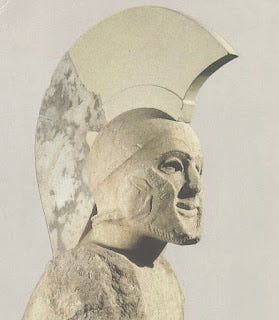
Leonidas in Historical and Modern Memory
The historical Leonidas was a legend in his own time. The Spartans built him a monument at Thermopylae, notably separate from the monument to the rest of the 300, and a second monument was built to him at home in Sparta. His body was brought home after the Persians had been driven out of Greece, which was an exceptional honour in a city-state that usually left their dead buried near where they fell. Nevertheless, the archaeological evidence suggests that larger monuments were built to the victors Pausanias and Lysander.
Nowadays, however, Leonidas is remembered better and more widely than either Pausanias, the commander of the Spartan army that defeated the Persians, or Lysander, who defeated the Athenians after a grueling thirty-year war. Spartan statesmen such as Lycurgus and Chilon are familiar names only to classical scholars. Leonidas, in contrast, is a cult and comic-book hero -- not to mention there is a chocolate company named for him.
In short, Leonidas appears to be more widely admired in the modern world than he was in his own times. This might have several explanations, the most likely of which is discomfort on the part of Leonidas’ contemporaries with adulating the commander of a costly defeat. The modern world, on the other hand, influenced by the Christian tradition, is more ready to honour self-sacrifice regardless of the immediate outcome.
Less understandable is a modern tendency to assume that Leonidas’ behaviour was “typical,” that he was “only” doing what Spartan society expected of him to do. These modern commentators have been misled by references to a monument that allegedly stood at Thermopylae with a text that is commonly rendered in English as: “Go tell the Spartans, stranger passing by, that here, in obedience to her laws, we lie.” This has been interpreted to mean that there was a Spartan law that forbade surrender or retreat. There was not.
The Myth of Sparta’s “Victory or Death” Ethos
Sparta had suffered many severe defeats before Thermopylae, and in no other battle did an entire fighting force die to the last man for a lost cause. For example, there is good reason to believe that Sparta lost the First Messenian War, and it was the ensuing economic and social dislocation that led to unrest and revolution. Certainly, Sparta was given a resounding thrashing by the Argives at Hysiai in 669 BC, but even so, the Spartans retreated rather than die to the last man. Roughly one hundred years later, Sparta again over-reached herself in an attempt to conquer Tegea, and again there were survivors; they were enslaved in Tegea and forced to do agricultural labour for Tegean masters. In 525 BC, a Spartan expedition against Samos likewise ended in humiliating defeat, but not the extermination of the expeditionary force. Finally, in the reign of Leonidas’ half-brother Cleomenes, a Spartan force under Anchimolius was attacked by Thessalian cavalry 1000 strong at Phalerum, and, according to Herodotus, “many Lacedaemonians were killed…and the survivors driven back to their ships.” Note, again, the survivors were driven back to their ships, which they presumably boarded and used to return to Lacedaemon. There is not a word about dying to the last man.
Nor did “death rather than surrender” become the standard for future Spartan commanders after Thermopylae. The history of the Peloponnesian War is littered with Spartan defeats; none were massacres. Even in the infamous case of 120 Spartiates trapped on the island of Sphakteria, the record shows that they surrendered and were taken off into (brutal!) Athenian captivity. Yet they were not written off by an indignant Spartan population, much less abandoned by the Spartan government as cowards or "tremblers." On the contrary, Sparta sued for peace and made serious concessions to Athens to have them released from captivity.
Leonidas’ Motives and Legacy
Leonidas’ stand was exceptional and should be honoured as such. Yet in his final stand at Thermopylae, he was to a remarkable degree “obeying Sparta’s laws.” He was obeying the intertwined laws which had shaped Sparta’s unique society. This society, far from being the proto-fascist state of modern imagination, was widely admired by ancient philosphers and statesmen from other Greek city states for being exceptionally orderly and harmonious. The laws that Leonidas honoured were nothing so simplistic as “do or die” or even “with your shield or upon it.” They were the entire body of interacting laws that created and defined a national ethos of honour, courage, incorruptability (not greed!), cooperation (not individualism!), and sacrifice for the common (not the individual!) good.
On the second day of the battle of Thermopylae, when the pass had not yet been turned and the situation of the Greeks was not hopeless, the Persian tyrant sought to buy Leonidas. He offered to make Leonidas king of “all the Greeks,” if only he would defect to the Persian side and become a vassal of the so-called “Great King.” Leonidas did not accept this bribe. He replied to the Persian envoy: “Tell your master that if he understood honour, he would not lust after what does not belong to him. I, Leonidas of Sparta, would rather die for the freedom of Greece than rule it in subjugation.”
Leonidas expected to die. An Oracle from Delphi had warned Sparta that one of her kings must die in battle or the city itself would be destroyed. Leonidas voluntarily assumed the role of sacrificial lamb.
Yet there is no reason to believe he expected to die in a defeat or that he anticipated that all his companions would die with him. He chose for his bodyguard only the fathers of living sons, not because he expected them all to die, but rather because he knew some would die and could not know in advance who that would be.
Leonidas undoubtedly hoped to fulfill the prophecy of Delphi by sacrificing himself in a victorious battle. He led an advance force of over 6,000 hoplites drawn from Sparta and her allies, which should have been strong enough to hold the Hot Gates until Sparta’s full army and the forces of other allies could reinforce them.
Yet after the pass at Thermopylae had been turned, Leonidas knew that the Persian army would advance unopposed into Central Greece. He recognised that it might sweep all the way to the Isthmus of Corinth before it again met with opposition. He may have feared that Sparta might find herself fighting virtually alone against the Persian onslaught. At that point, his military objectives shifted from trying to hold a position to:
giving the other Greek contingents time to withdraw and live to fight another day, and
increasing Persian respect for and fear of the Spartans.
He did not sacrifice himself because “Spartan law” demanded it; it did not. He did not sacrifice himself out of vanity and the desire for fame; he could have satisfied both by accepting Xerxes’ offer of all Greece. He remained at Thermopylae with roughly 1,000 men (300 Spartiates, 700 Thespians, and several hundred Thebans) for specific and sound military reasons. He sacrificed a few, including himself, to save the many.
Such a stand for the sake of others is the antithesis of modern gun-rights activists who defy central authority. It is the antithesis of rightwing activists who claim the “right” to ignore laws and government authority to decide for themselves when they can turn their weapons against their fellow citizens.
Leonidas, in contrast, neither raised himself above Sparta's law nor claimed special privileges, although he was a king. Leonidas put his duty to defend Sparta — and other democracies — ahead of his self-interest, ahead of his own life.
If only America’s current leaders had so much self-respect, honour and courage.
Leonidas’ reign, which started ten years before his heroic stand at Thermopylae, is the subject of A Heroic King.
His earlier life, from his boyhood through the years when he was only one of Sparta’s citizens, is described in A Boy of the Agoge, and A Peerless Peer. Other novels set in Ancient Sparta are described on my website here.
Next week, I will share the story of another man who died for Greek liberty. He was killed fighting an invasion by the armed forces of a 20th-century despot. He incorporated military virtues, reminding us of what that is at a time when America’s most powerful general has sold his soul like a common mercenary to serve a convicted criminal intent on destroying the nation he was elected to serve and preserve. I hope you’ll join me in remembering a good soldier — and the things he fought for.

Hello Helena - Just want to say that I am learning a lot from your newsletters. Thank you for your work!
Great article. Just beforehand, I'm on SS so I have no money to spare to support your substack; I wish I did.
I consider the Stand at Thermopylae, a Human Sacrifice. A Sacrifice not by another but by the victim and victims. The pagan viewpoint of their gods that when a tremendous thing is needed, only a human sacrifice will do. That is what Delphi ordered. The Spartans were a tremendously religious and pious people. It fits. That is why only men with living sons were part of the bodyguard because they were all expected to guard the king, even to death. Yes, it was hoped for a win--but this wasn't a defeat--but a huge win. God really does require human sacrifice. Leonidas' sacrifice bought Freedom for the WHOLE Western World. The second sacrifice was Socrates who gave the birth of Intellectual Truth and Ethics (which he learned from the Doric Greeks, i.e. the Spartans) and then Jesus Christ. There is a deep connection between all three, Leonidas, Socrates and Jesus Christ. All three laid down their lives FREELY. All three had a chance to escape. All three chose Death. All three were Sacrificial Lambs. Leonidas to the West. Socrates to Intellectual Truth. Jesus Christ, Spiritual Life. All three were about Life. Leonidas didn't just die for Sparta; he died for Greece---he died for the birth of the West. The American Classicist Edith Hamilton said that the West was in a precarious position. Only the defeat of the Persians gave the West Life. Plato said the same thing.