

When Conscience Demands Treason
Opposing Aggressive War from Within

Unlike Donald Trump, Adolf Hitler did not start attacking sovereign countries in his first year in office. Indeed, for five whole years, he refrained entirely from bombing other nations or sinking their ships, much less kidnapping their leaders and plundering their resources for personal gain. It was not until March 1938 that Hitler informed his senior military leaders of his intention to annex Austria.
It may surprise many readers that when Hitler revealed his aggressive intentions to his senior generals, they reacted neither with jubilation nor blind obedience. On the contrary, the Chief of the German General Staff, then the equivalent of the U.S. Chairman of the Joint Chiefs of Staff, refused point-blank to take responsibility for such a foolhardy action.
Hitler countered by assuring his generals that the Austrian army would not resist his “special military operation” and that no foreign power would come to Austria’s assistance. (Of course, Putin thought that too, but we won’t go into that here.) Still, the German army leadership insisted the action was illegal and dangerous.
Hitler then played his “trump,” saying that if the Army would not do as it was ordered, the SS and the SA would. (I wonder if all those ICE agents know they may someday be sent not to shoot peaceful mothers and healthcare workers but rather to confront, say, Canadian and Mexican tanks, artillery and fighters?)
In 1938, the Chief of the German General Staff caved in and agreed to organise the invasion. Within two days, plans were drawn up, and they worked splendidly. Hitler, it turned out was better at predicting reactions than Putin, and the Wehrmacht faced neither Austrian resistance nor intervention by Austria’s Western allies.
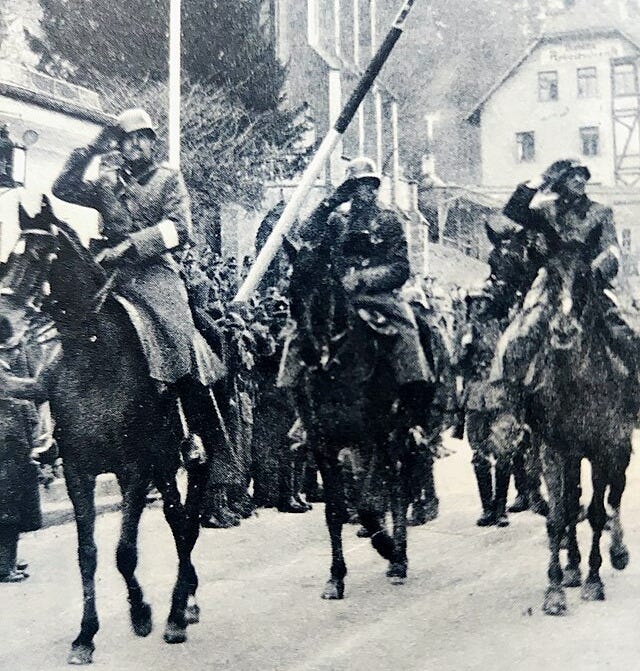
Naturally, success whets the appetite. Hitler hardly had time to recover from all the flowers thrown at him and the banquets held for him in Austria before announcing that it was time to “solve” the "Czechoslovakian Problem.” Hitler explained to his senior military advisors that he intended to annex the ethnically German “Sudetenland,” which had been taken away from the Austrian Empire at the close of WWI.
The population of the region had initially sought independence as Deutschböhmen (German Bohemia) or union with the rump Republic of Austria, but the victorious allies of WWI had handed the region over to the newly created Czechoslovakia by the Treaty of Saint-Germain-en-Laye in 1919. In doing so, they had clearly ignored the principle of “self-determination” touted by President Wilson, and this violation of their own alleged principles had been a source of tension and grievance ever since. Naturally, Hitler couched his plans to occupy the Sudetenland in terms of ‘liberating’ the ‘oppressed’ Germans from ‘Czech oppression’ in violation of the promises made by President Wilson.
Regardless of Hitler’s justification, this “special military operation” entailed the invasion and occupation of territory held by a sovereign nation and so constituted an act of aggression. Alarmed by such rashness, the Chief of the German General Staff wrote a series of ever more desperate memos outlining the risks of the proposed action. Unfortunately for him and those who supported him, intelligence and general staff studies suggested that Czech resistance to the invasion could probably be crushed before Czechoslovakia’s allies (Britain and France) could come to its aid. This assessment satisfied the mercenary and MAGA — sorry, Nazi — generals, but not all German generals and most especially not the Chief of the General Staff. He remained staunchly opposed to an invasion.
Recognising that the insane dictator was impervious to logic and indifferent to the pain his policies inflicted, the honourable general appealed to the conscience of his fellow generals in a memo dated 16 July 1938. He wrote:
The very existence of the nation is at stake. History will attribute a blood guilt to leaders who do not act in accordance with their professional expertise and political conscience. Your military duty to obey ends where your knowledge, your conscience, and your responsibility forbid the execution of an order. If in such a situation your advice and warnings are ignored, then it is your right and your duty before the nation and history to resign from your position.
Resign? In the face of a threat of such magnitude? “The very existence of the nation is at stake,” and the answer is to resign???
Collectively, it should be noted. The idea was to take away all military expertise in a single blow. Yet as the drafter of this memo already knew, if the military leadership refused to obey, the SS and the SA were only too eager to take their place.
In short, what a waste of time! Totally pathetic! Sheer show and theatre!
Except it wasn’t.
The author of the memo was, in fact, seeking an open confrontation between the army — as the representative and protector of ‘traditional values’ such as rule of law — and the SS and the SA as representatives of the fascist (e.g. Nazi, MAGA) state. The confrontation was intended to create an opportunity for the German Army ‘to restore the rule of law.’ The general had even developed slogans the Army should use to explain their actions to the population:
“Gegen den Krieg!” / “Stop the War!”
“Freie Meinungsausserungen!” / “Free Speech!”
“Wieder Recht im Reich!” / “Restore the Rule of Law!
“Kein Bau vom Palaesten!” / “No Palaces!” (Read: Ballrooms)
“Schluss mit den Tschekamethoden” / “End the Terror” (End ICE)
Put together, the political agenda advocated by the Chief of the German General Staff in July 1938 was nothing less than a complete end to National Socialist policies. Formulated at a time when Germany had not yet gone to war, much less suffered any defeats, it disproves the commonplace misconception that the German military resistance to Hitler was motivated by nothing other than a shallow desire to avoid unconditional surrender.
Unfortunately, by this time, Hitler had already purged the senior ranks of his military. (See: Dangerous Alliances.) The men who occupied the most important command positions were already puppets of the dictator, happy to risk the “blood guilt” for another promotion, fame and glory — men like Don “kill-for-Trump” Caine. They refused to join their Chief of Staff in a ‘joint resignation.’ So, on 15 August 1938, the Chief of the German General Staff, Ludwig Beck, resigned alone.
Beck went silently, without so much as a public statement of his motives. His public silence caused junior officers who detested the Nazi regime to feel betrayed. They felt his resignation had achieved nothing.
They were wrong.
Beck’s attempt to mobilise collective and open opposition to Hitler based on rational argument and responsibility for the nation was a necessary precondition for the creation of a conspiracy to destroy the Nazi regime. Only when all legal and peaceful methods had been exhausted could mature and responsible men be moved to take the difficult step of contemplating illegal action against their own government.
Furthermore, there is evidence that suggests Beck requested two staunch opponents of the Nazi regime, General Carl Heinrich von Stuelpnagel and General Erwin von Witzleben, the Commander of the Berlin Military District, to develop plans for the arrest and neutralisation of the SS and SA in Berlin. Certainly, within a month of Beck’s resignation, the first plans for the arrest of Hitler and the declaration of martial law had been made. Beck’s public and open confrontation with Hitler had failed, yet his conspiracy against the Nazi regime had only begun.
In the United States today, it is reasonable to assume that — just as in Nazi Germany — there are both opponents and supporters of fascism within the military. It is notable that many American veterans have stood up to Trump and called him out for his aggressive and irresponsible foreign policy. They have been especially outspoken and forthright with respect to his contemptible threats to our neighbours (both Canada and Mexico!) and our Allies, such as Denmark. The members of Congress who joined Sen. Mark Kelly in reminding service members not to follow illegal orders deserve particular recognition. Adam Kinzinger had been another strong spokesman for sane foreign policies and the rule of law. Yet I’d like to quote Graham Platner, a candidate for my Congressional district in Maine, who wrote particularly clearly:
The government of the United States of America has illegally invaded a foreign country and kidnapped its leader. This is not foreign policy. It is international gangsterism.
Trump — like Hitler — couldn’t care less.
Meanwhile, a large number of senior military officers have resigned. Although there appear to be many more eager to take their places and sell their soul for a promotion, we cannot and should not judge them in advance. As America moves ever closer to the precipice of war, we can only hope that there are those within the U.S. Armed Forces with the intelligence and integrity of Ludwig Beck — and that when the time comes, they will not need to act alone.
The best means for understanding history is through the empathy-building media of fiction.
A Novel of the German Resistance to Hitler
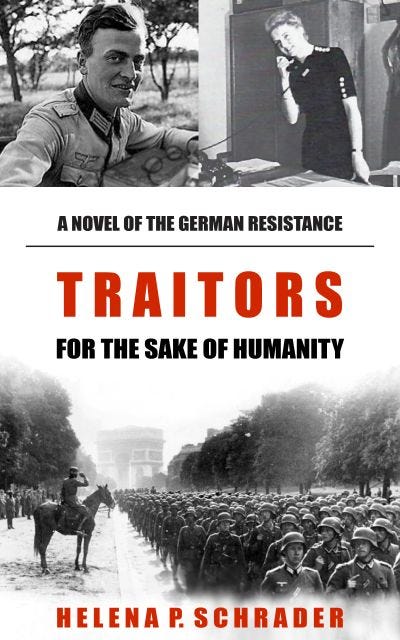
The question of when treason becomes a moral necessity is the core of my novel, Traitors for the Sake of Humanity. It follows the fate of a fictional officer who, like Beck, realises that his ultimate loyalty belongs not to a leader or a party, but to the rule of law. It also sheds light on another kind of resistance — the kind we’re seeing across America now — the humanitarian resistance offered by ordinary people to the victims of a genocidal regime.
“…the importance of this book cannot be overestimated. Traitors for the Sake of Humanity rises as a critical, provocative, and timely book that we would all benefit from reading. … Helena P. Schrader puts a human face on some ‘monsters,’ and exposes the monstrous faces of others. Kudos, Dr. Schrader.” Chanticleer Review
Find out more and read more reviews of “Traitors“ at the publisher’s website: