

The Dangers of Cryptocurrency Explained
The Intimate Relationship between Corruption, Crime and Currency

As Robert Reich pointed out in his article Trump’s Calamitous Crypto Corruption, the convicted criminal occupying the White House is waist-deep in cryptocurrency. He is one of the driving forces behind its expansion and growth. As with all his actions, his primary goal is to enrich himself unscrupulously. If he succeeds, the rest of us will pay the price.
Cryptocurrency is rapidly gaining popularity. According to some estimates, in new markets such as South America and Oceania, use has doubled over the last year. Around the world, the vast majority of cryptocurrency investors are young and male. They appear to be attracted by the ‘high-tech’ character of the product and the aura of being ‘financially savvy’ and ‘innovative.’ They like to think they are going to make a ‘killing’ (i.e. become billionaires) because they are playing a game with (or imitating) the ‘tech bros’ of Silicon Valley — and for those in the MAGA movement, their beloved Leader.
Yet despite being digitalised and ‘secured’ by blockchain technology, cryptocurrency is at its core a simple scam. It is not backed by assets. It is neither regulated nor controlled. Worst of all, unlike most currency scams of the past, cyrptocurrency can be created by any rich fraudster. Yet we know — or ought to know — based on the historical record that currencies lacking assets and regulation ultimately destroy, rather than create, wealth.
Because most of us don’t understand “blockchain” technology and can’t quite picture what “cyrptocurrency” is, much less how it works, we tend to look the other way and focus on problems that are more tangible and immediate. For a nation that can’t remember having a worthless currency, it is easy to believe the dollar is inherently strong and always will be. As a nation, we have forgotten what it is to have a worthless currency. So let me remind you what it looks like.
When Nazi Germany surrendered in May 1945, Germany ceased to exist as a sovereign state. In consequence, all government institutions disappeared — not just the obvious manifestations such as the chancellery, parliament, police and armed forces, but ‘details’ such as the central bank, too. With surrender, the German currency, the Reichsmark, became worthless.
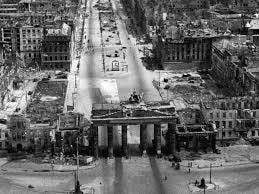
The victorious Allies were sophisticated, functioning states, and they had anticipated this development. To prepare for occupying a state without a valid currency, they decided to create and print ‘occupation currency.’ Naturally, the Soviets (as equal partners in the struggle against Nazi Germany) insisted on being given a set of plates for printing this new money, the ‘occupation marks.’ They promised to provide a strict accounting of the notes they produced on them. In fact, they never even bothered with internal accounting. (If this sounds like DOGE, it is not surprising! Crooks have recognisable behaviour patterns!)
Instead, the Soviets printed ‘occupation marks’ recklessly and used them to pay their soldiers years of back wages. The Soviet soldiers found their pockets bursting with tens of thousands of ‘marks’ that they were strictly prohibited from taking (or sending) back to the Soviet Union. They bought everything they couldn’t steal with as many marks as they had. Uncontrollable inflation inevitably ensued. In almost no time at all, the occupation ‘marks’ were worth less than toilet paper — literally.
With the money worthless, people turned to barter. Direct exchanges were the first and most obvious form of barter, and food was the most essential — but not the only — commodity that people needed to buy. Since farmers refused to accept the discredited ‘occupation marks,‘ to obtain food city residents had to give farmers things they wanted: a Persian carpet for a sack of potatoes, the family silver for a side of ham, etc. etc. Since Persian carpets and silver don’t reproduce themselves, upper and middle-class city dwellers got progressively poorer, while the poor, who had no Persian carpets or silver to sell in the first place, were forced to commit crimes, engage in prostitution or starve.
Since people needed more than just food (e.g. shoes, blankets, winter coats, soap, candles, maybe a sewing machine etc.), it wasn’t always clear where to go to find such items, so informal or ‘black’ markets sprang up. Here, instead of outright barter, a few small, light yet durable objects such as cigarettes, liquor and nylons became a de-facto shadow currency. People sold their possessions for these fungible things and then used them to buy what they needed.
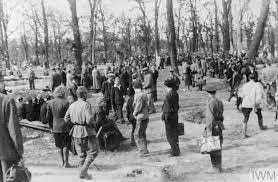
Perversely, the very items vital to oiling these informal markets were commodities that the occupation forces (who didn’t need to barter to live) could access at subsidised prices. Let’s take the example of a carton of American cigarettes, available for purchase in the PX at 50 cents. This carton could be exchanged for $150 worth of goods on the black market. Meanwhile, skilled German workers earned as little as 180 occupation marks (at the above rate of exchange for cigarettes, $0.06 — six cents) per month. A pound of butter cost sixty dollars (6,000 – 9,000 occupation marks at the official rate), and a loaf of bread, twelve dollars (12,000 – 18,000 occupation marks).
Given the disparity between wages and prices, it is hardly surprising that a social worker reported to the U.S. Governor General Lucius D. Clay: “Many people find it not worthwhile to work for a wage. It takes too much time away from earning a living on the black market.”[i] Provided, of course, one was able to get hold of the barter-currency.
Since the occupation soldiers were the primary source of the unofficial barter currencies, the best means of obtaining these goods was by ‘servicing’ the occupiers. While prostitution was the most obvious expression of the crime bred by the need for this uncontrolled pseudo-currency, robbery and murder were rampant, too. In addition, gambling and drug dealing flourished. In short, crime was driven directly by the lack of a sound currency that could be earned legitimately.
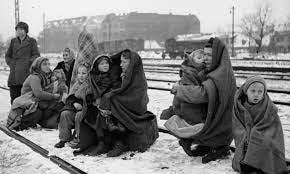
One American observer claimed that, “life … as an organised industrial community had come well-nigh to a standstill and, with it, so had the production and distribution of goods of every sort.” Furthermore, agricultural production was “lower than at any time since the turn of the century.”[iii]
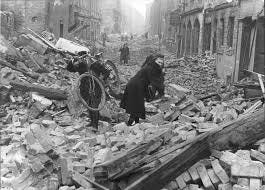
Germany was trapped in “a vicious circle in which the Germans starved because they could not produce enough and could not produce enough because they were starving.”[v]
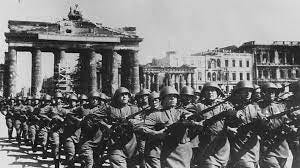
The architect of this disaster, Stalin, was delighted. By destroying the value of the ‘occupation mark,’ he had succeeded in creating the kind of crisis that bred ‘revolution.’ After three years of systematically breaking Germany’s capacity to produce anything at all, all of Western Europe was living on life-support from the U.S. Despair, anger and political radicalism was growing. Stalin licked his lips. All he needed to do, he calculated, was organise a few more ‘popular uprisings.’ Then the Red Army could roll all the way to the Atlantic to ‘liberate’ the ‘oppressed’ in the rest of Germany, France, Belgium, the Netherlands and Denmark to bring them the joys of Stalinism, too.
The United States made a preemptive strike against that eventuality. On June 5, 1947, the U.S. Secretary of State publicly announced the establishment of the ‘European Recovery Program,’ better known to posterity as the Marshall Plan. This plan put the vast resources of the U.S. at the disposal of a still destitute Europe. Marshall stated explicitly: “Our policy is directed not against any country or doctrine, but against hunger, poverty, desperation and chaos.”[viii] Its goal was “the revival of a working economy … to permit the emergence of political and social conditions in which free institutions can exist.”[ix]
The very first step — before Marshal funds could flow into Germany — was the re-introduction of a sound and regulated German currency. In place of a currency cynically and arbitrarily printed without assets or regulation (like today’s cyrptocurrency) by a power intent on creating chaos (read charlatans intent on maximising their own profit), Germany needed a regulated currency managed by non-political and non-corrupt bureaucrats. On March 1, 1948 a new German central bank was established that in due time became the Bundesbank.
As soon as this bank came into being, people knew what was coming: real money! Consumers rushed about trying to buy up everything they could to get their hands on in order to get rid of their play money. Meanwhile, manufacturers and retailers hoarded their products until they could be sold for money worth having.
On June 25, the Deutsche Mark or D-Mark was born. It bore no resemblance to cryptocurrency. It was a sound currency controlled by a sovereign and regulated central bank headed by financial experts, who did not profit from currency manipulation. At once, goods that had not been seen in years appeared in store windows. Workers had an incentive to work, and entrepreneurs had an incentive to invest. Confidence in the new currency grew rapidly. It laid the foundation of what was later known as the German “Economic Miracle.”
The architects of cryptocurrency, on the other hand, wish to run this script backwards. They want to move the United States away from a functioning economy with a sound currency, regulated and managed by an autonomous central bank. They want to create instead competing, unregulated currencies that can be exploited for profit by faceless, unaccountable actors.
Their scheme will create chaos, foster corruption and cyber crime — for the sole purpose of enriching the billionaires — like Trump — behind the cryptocurrency scams.
Tragically, it is not only the buyers of cryptocurrency who need to beware. All who rely on the value and stability of the U.S. dollar should tremble at the thought that these currency charlatans are seeking to destroy the autonomy and professionalism of the U.S. Federal Reserve. If they succeed, the U.S. will soon look like Germany in 1948.
The situation in Berlin in the aftermath of WWII is the setting of award-winning Cold Peace. The first book in the Bridge to Tomorrow Series, Cold Peace depicts the urgent need to introduce currency reform along with other pressing issues as seen through the eyes of British, American and German characters. It is available from amazon and Barnes and Noble in both ebook and paperback formats. Find out more, see the awards and read review excerpts here.

[i] Collier, Bridge Across the Sky, p.30.
[ii] Haydock, City Under Siege, p.119.
[iii] Thomas Parrish, Berlin in the Balance, pp.99-100.
[iv] Collier, p.10.
[v] Robert Jackson, The Berlin Airlift, p 24.
[vi] Ann and John Tusa, The Berlin Airlift, p 44.
[vii] Roger G. Miller, To Save a City, p. 8.
[viii] Parrish, p. 120.
[ix] Parrish, p.121.